
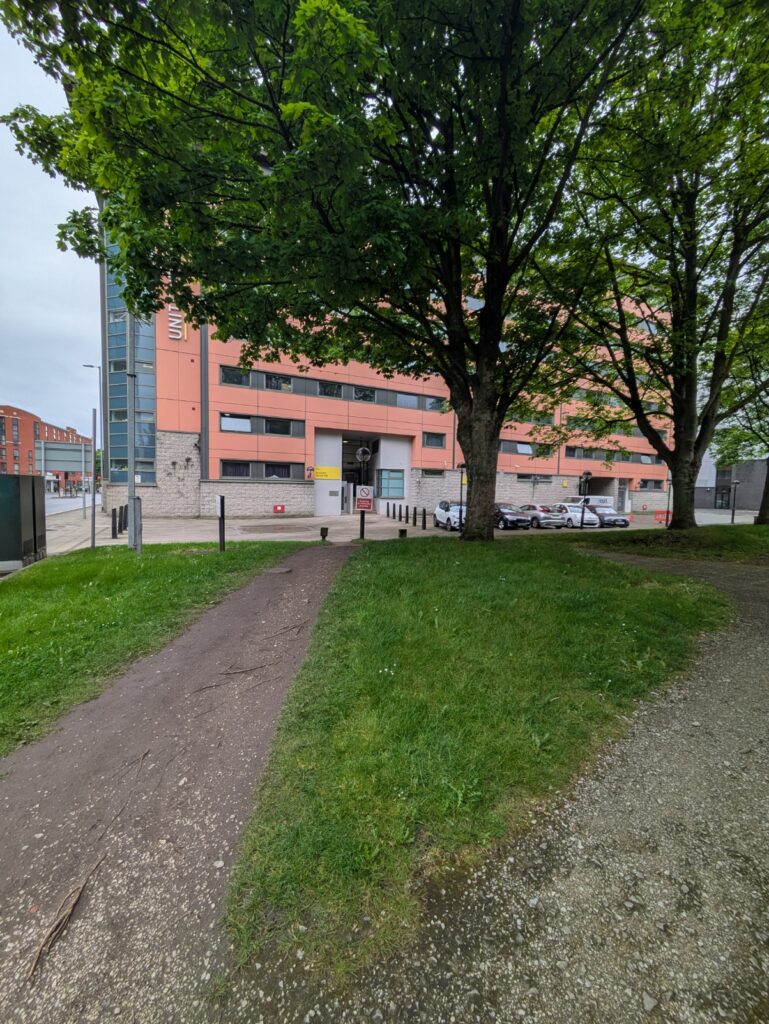
The formal process is rarely the same as the process people actually follow.
The concept of Desire Paths or Desire Lines has been around for over a century. Whilst the field developed significantly in the 1980s, the idea can be traced back to Joseph N. Bradford at Ohio State University.
Rather than setting the paths across the campus at Ohio State when the buildings were built, he waited until winter and mapped the paths that the students took across the snow, watching how they moved rather than the way in which the architect and architecture wanted them to move. After mapping the natural paths the students and faculty took across the campus, he created asymmetric paths across the grass between buildings, providing an opportunity for people to follow their naturally inclined paths between buildings.
This concept is not alien to those who design websites, if you want someone to purchase a product or sign up to a newsletter, you make it easy for them to do so. Painless. You don’t make them walk an unnaturally long way around the edge of the grass to get to the building directly opposite the one they came out of.
This is something we need to bear in mind when we are trying to understand how a business operates; we shouldn’t just be looking at a firm’s processes, but also at the shortcuts around and exceptions to the process which aren’t documented.
Unlike Michigan and Ohio State universities, which have both taken a similar approach to campus design, the supporting infrastructure of financial planning firms often lacks a clear plan and strategy. Bradford was the architect of the Ohio University campus, he left space in the campus for people to walk about, and mapped the ways they moved around. Unless you’re starting from scratch or have the budget to create a masterful rebuild of all systems, you’re going to be within the constraints of an existing structure. Yet, that structure often lacks a clear plan. Michigan has Bradford’s plan and, arguably, any financial planning firm that wants to scale or integrate new ways of working needs a proper plan as well. A blueprint, not just of their IT systems, but of all the ways in which those systems interact with the real world, and with the humans who use them.
The systems-architecture of a financial planning firm does fit the campus analogy well if you think about it. Most people will be following one or two very clear routes based on a standard operating model:
Enquiry meeting > Initial Fact Finding Meeting > Cashflow Model > Written Recommendation > Recommendation Meeting > Implementation
There will also be those who are already in the post implementation stage:
Review Preparation > Cashflow Model > Review Meeting > Modification
But we know that some will leave the review meeting needing modification and new business, so they join the new business process in the middle rather than in the beginning. People also come at the cashflow model from different directions; initial fact finds and pre-review preparation.
There will be those who are looking for transactional advice on protection arrangements, who aren’t necessarily going to need an annual cashflow model (though I did once have an adviser tell me he’d spent 2 days producing a cashflow model for a protection only client). There will be those who “just” need £10k from their ISA, tomorrow, preferably in non-sequential bills…
Imagine our process stages are buildings on a campus. If a firm has two services, one which provides an annual cashflow model and the other which does so once every three years, there will be years when the client pathway goes from Review Preparation (A) to Review Meeting (C), and some years when we go via Cashflow Model (B).
A
| \
B – C
If we don’t create the appropriate structure to allow movement from A to C without going through B, we’ll end up with an “unscripted” process. This unscripted process is a desire path in our operations. We need to get from A to C, and we’re not going to walk all the way round to B to get there.
People cut corners. Everywhere. Not necessarily because they are lazy, but because the way the world is asking them to move is not aligned with the way they feel it should be.
Keep off the grass signs don’t work, both literally and figuratively. Somewhere in my photo library I have a picture I took in 1997 of a “Keep off the Grass” sign poking out among a sea of people who clearly weren’t going to let someone’s arbitrary rules get in the way of their personal enjoyment.
If we haven’t created an effective pathway or process for people to get from A to C without going via B, they will make their own way there. When people choose their own way across the grass they may well make a mess, they might cause damage we can’t easily repair.
This metaphor is becoming a little laboured, but before we put it to bed we should consider the impact these desire paths have on the implementation of new technological wizardry. It’s all very well wanting to improve efficiency, scalability and so on, but if we don’t take into account the desire paths that already snake across the grass between components of existing processes which aren’t going to be replaced by whatever new system we put in place, we’re going to be in for a nasty shock.
Just wait until people start to purposely walk across the grass and sit in the middle of the lawn next to the “Keep of the Grass” signs because they are protesting the new system you’ve implemented!
When thinking about the effective integration of platforms, client information systems, cashflow modelling, AI tools and the like in financial planning, even the ones you’ve been using for years, it’s important that we look at the desire paths people have created and how they actually use the systems. If we don’t take into account peoples’ existing shortcuts, the natural pathways in existing process, not only are we failing to recognise their importance in how the more fleshy components of the business operate, but the efficiencies and improvements we hope to achieve with whatever we are implementing may vanish, or go into reverse.
A word of warning. This is made all the more difficult when systems are purchased based on demo by people employed by the provider working with a clear, simple, stand-alone case. Life is rarely straightforward.
Even if demonstrators work with complex cases, they are cases they have uploaded into the system and run through the process on countless occasions: They know how to make that case work. That’s not the same as someone in your own team working out how to do so in a live environment.
Some providers offer limited time free trials, giving you 7, 14, 30 days to decide whether this is the right thing, but if these are only explored by one person who doesn’t know the secret paths and hidden ways which keep your business together, then you’re going to cause yourself some serious problems down the line.
This is why, when you’re thinking of putting something in place you need a plan, and you need to bring together different parts of the business to get there.
Objectivity is important. Someone who only ever walks from Engineering to the canteen and back isn’t going to know the paths taken by someone doing joint honours in philosophy and mathematics. Bradford took a literal “bird’s eye” view, he got in a hot air balloon. If you want to understand how your processes work, and want someone to take an objective view of how everything fits together, and the impact of new technology and systems might have on this, give us a call, we’d be happy to hop into that hot air balloon with you, and help you see.
(The image used in this article was taken in Manchester in June 2026, however the idea for this article actually occurred to me walking back from the PFS Conference at the Excel in London in late 2025.)